Uniting Distant Stars put its passion into action in 2012 by launching projects in Liberia. We invite you to read our first annual report (click here) on what we accomplished in 2012 and what we intend to do in 2013 and beyond. We look forward to your continued support and feedback on what we are doing. Thank you to all of you who have followed our work and shared it with others.
Tuesday, April 9, 2013
Saturday, March 23, 2013
Water: Respect this life-giving resource
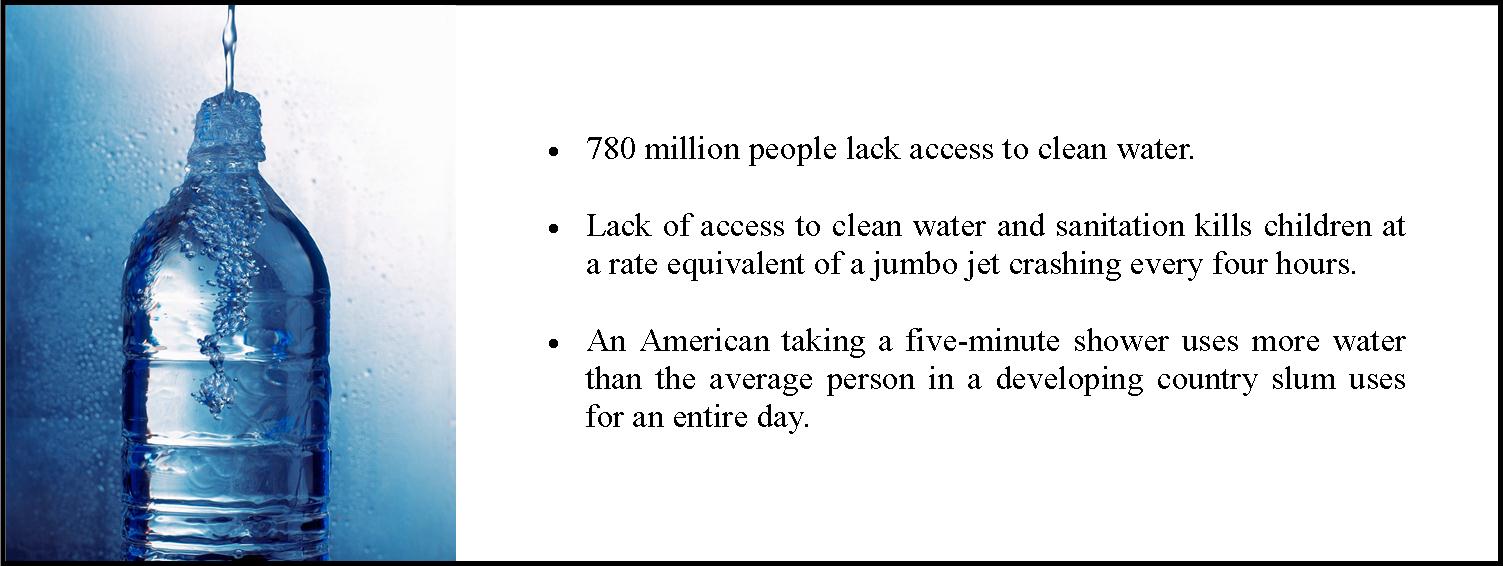
March 22, 2013 was World Water Day. This is a day where those of us in the developed world should pause before we turn on the tap and allow one of the earth's most precious resources flow down the drain. We should reflect on how this shared vital resource was intended to quench the thirst of our global community; however, 780 million people lack access to clean water.
So, let's take a moment and imagine that we are a teenage girl in sub-Sahara Africa getting up at the crack of dawn to fetch our family's daily water supply. We leave our mud hut with a 5-gallon jug balanced on our head and start our long journey to the nearest river which is five miles away. As we take a deep sigh knowing this is just the first leg, because we need to repeat it three more times to get our family's daily allotment for cooking, bathing, washing clothes and drinking. As we take our subsequent trips, our pace begins to slow from the burning heat of the blistering sun. Soon the weight from the water sloshing back and forth in the bucket is taking a toll on our arms, legs and back. The river that we hauled this water from may not be free of contaminants thus putting our family at risk of being infected by a water-borne disease such as cholera.
Now you have contemplated the realities of countless women and girls around the world, who fetch a mere fraction of what we use in water on given day. What if we truly walked in their shoes? Would we let the water run while we brush our teeth or turn on the shower then go do something else? Would we worry about watering our lawns or washing the dirt from the siding of our house? These are important questions to ponder the next time you reach for the faucet.
From living in Liberia for two separate years, I have learned to appreciate the value of water. The picture collage below is of my bathroom in the house I rented in 2009 to 2010. Unlike most people in Liberia, I was blessed to have a bathroom in my house. Though it had no piped in water, the water I used was fetched from the well next door at the landlords. In the picture on the left, the green storage bin held the water for bathing and flushing the toilet. The white 5-gallon bucket in the tub is what I used for bathing. The middle picture is what I call my water heater, because this thermos contained the hot water I would use for my daily bath. The picture on the right it what I like to refer as my shower head, because I dipped this in the bucket and poured the water over my head to rinse. Since I was not sure if the water was treated, I poured a cap-full of a liquid antiseptic into my bucket before bathing. Additionally, I drank and brushed my teeth with bottled water. Compared to most Liberians, my inconvenience was bearable and made me aware of how lucky I was to have running water in my home country.
Fortunately, most of us in the developed world have piped in water that we can use with minimal interruption. Unfortunately, we usually take this life-giving resource for granted and allow it to be wasted. Though we possess the knowledge that water covers about 70% of the earth, we fail to realize that potable (i.e. drinking) water only represents less than 3% of this vast supply and it is being rapidly depleted in areas such as the Ogallala Aquifer. Many of these fresh water sources are continually contaminated and polluted from various human activities such a manufacturing and agriculture. So, as another World Water Day has moved on, can we take this shared precious resource for granted anymore?
Wednesday, February 27, 2013
Ode to a Toilet: The Project Begins
This post will convey the importance of having a proper
sanitation system and what Uniting Distant Stars intends to do about this in
2013. First, let’s identify the role of the toilet as follows:
Ode to a Toilet...
You go by so many names: commode, loo, john, pot, throne, porcelain god,
and so on.
You serve a greater purpose by “flushing” away our bacteria-laden waste
to maintain good health.
You allow us to “rest” for little or long while as we contemplate our
to-dos for the day.
You are often taken for granted by those who are fortunate to have one [or
more] in their home.
You can be designed to convert our waste into fertilizer and even
energy.
You are a simple device that can be easily maintained with just a
little care.
You need to be honored and recognized for selfless commitment to our
overall well-being
Here is the “poop”
why toilets matter…
- Approximately 2.6 billion people (37% of the global populations) lack a proper toilet.
- Those without a proper sanitation system are forced to openly defecate in areas that can contaminate water leading to the spread of diseases. Note: “one gram of feces may contain 10 million viruses, one million bacteria, 1000 parasite cysts and 100 worm eggs.”
- Some of these diseases include diarrhea, cholera, dysentery, typhoid, and hepatitis A that can kill approximately 115 people in Africa every hour.
- Adequate toilet facilities that are private and separate improve the attendance rate of school children and the enrollment of girls.
- There are many more reason why a proper sanitation systems and hygiene standards is necessary for economic and other reasons.
Source: WHO
10 Facts on Sanitation
In 2012, Uniting Distant Stars initiated an adopt-a-school
project in Liberia to support the education of approximately 250
children
at the Russ Wood Christian Academy. This commitment is beyond providing
books and pencils, and includes the overall
well-being of these children. This is why we have taken on as our 2013
capital improvement project the replacement of its substandard latrine
(see pictures below) with an environmentally
friendly and sustainable model.
We recently put out a request for toilet models on Facebook and
Linkedin. To date we have received five responses from various organizations having WASH (Water,
Sanitation, and Hygiene) programs in developing nations. Three have already
submitted their model types and are currently being reviewed. We plan to select the
three models that meet the following criteria:
- Uses no water
- Inexpensive and simple to construct by community members and students from a local trade school.
- Easily maintained and long-lasting
- Appropriate for the Liberia cultural and environmental standards
We will continue to develop this
project and provide an update after we have met with the school administration on
what model they chose. We are still accepting recommendations of model types that meet our stated
criteria. Please submit to info@unitingdistantstars.com.
Friday, January 25, 2013
Staying Curious
When we tap into our curious spirit, we are more likely to expand our knowledge base and adapt our skill set to meet the demands of this ever changing world. Granted, most people are change-averse, but it is one of the two guarantees in life--the other being death. We must learn to let go of a past that no longer serves us and learn to embrace a life that is a continuous exploration into the unknown. Basically, when we challenge ourselves to learn or do something new, we are tapping into a new realm of possibilities.
This requires a change in how we think and see the world. One of my favorite quotes from Albert Einstein is “We can't solve problems by using the same kind of thinking we used when we created them.” This statement holds many truths, from the individual to the national level. We often limit our possibilities, because we have set imaginary constraints on our thoughts. Too often our thinking gets stuck in the mud like this truck.
What is exciting about changing our thoughts is that there is now technology that can show us what is happening to our nerve cells in our brains. With the development of better brain scans, scientists can examine how a novel idea is being formed in our neo-cortex (front part of the brain) through the learning process. Then it can show through time-lapse video how our brain can rewire itself when a new habit is being developed (click here)[1]. Being able to see what our brains can do when we change our thinking is amazing. Also, this ability can happen at any age...so yes an old dog can learn a new trick.
The curiosity to learn or do something new takes an open mind. I like to look at the world with the eyes of two year old. It was during this time of our life that we were discovering a larger world and were eager to try everything. If we can harness this fearless enthusiasm again as adults, we can plug into our creative and innovative centers in the brain. The reality is if we want to change how we see the world, we need to develop creative and innovate thinking that is not hindered by fear of failing or doubt of our abilities.
The idea of being curious is important to our ongoing personal and professional development. As we continue to learn, we continue to grow. This is why we need to explore and experience the greater world around us, because it expands our opportunities. I will close this post with a great quote from Audrey Hepburn, "Nothing is impossible, the word itself says 'I'm possible'!"
Footnotes:
Video: Look What Happens in Your Brain When You Change Your Mind. Dr. Joe Despenza
Labels:
Albert Einstein,
Audrey Hepburn,
brain,
creative,
curiosity,
Curious,
Dr. Joe Despenza,
fearless,
innovative,
Liberia,
Lofa County,
neo-cortex,
new habit,
open mind,
thinking
Saturday, December 22, 2012
A Simple Wish For A Better World
We live in a world where money and things often define one's worth. Yet, most people living in developed nations take for granted the simple and basic things that arguably should be available for everyone on this planet. Many of us fail to realize that those living in extreme poverty did not choose to do so. According to the World Bank statistics on poverty in 2008, "1.29 billion people lived in extreme poverty below $1.25 a day, equivalent to 22 percent of the population in the developing world." This equates to about 18% of the world's population.
This post is based on a simple wish that is achievable with a little actual effort by everyone. I got this idea from Dr. Muhammad Yunus, founder of Grameen Bank and 2006 Nobel Peace Laureate, who developed ten indicators that determined when someone had moved out of poverty. When I first read these indicators in his book "Banker to the Poor" and again in his other book "Creating a World Without Poverty", I gained the insight that only one thing stops people from achieving self-sufficiency. That one thing is access to resources needed to put their talents to work.
For the past year, I have been reciting a simple wish as a daily ritual during my long morning commutes to work. I have modified Dr. Yunus' model to focus on the the basic necessities that no one of us should ever take for granted. Following are ten parts of my wish illustrated by a photograph or statistical statement that allows you to reflect on the meaning of each one.
1) May everyone have a roof over their head that protects them from the elements, and the temperature inside is comfortable no matter how hot or cold it is outside.
2) May everyone sleep on bed that is above the floor and not overcrowded.
3) May everyone enjoy an adequate number of nutritious, tasty and satisfying meals per day that are prepared on a clean and safe cook stove/oven.
4) May everyone quench their thirst with clean, fresh and safe drinking water whose source is near their home.
5) May everyone have a private, hygienic, and environmentally friendly sanitation system and shower facility that is easily accessible.
6) May everyone have access to affordable, reliable and compassionate healthcare that is within a reasonable distance and may they not be turned away if they are unable to pay.
7) May every child receive a world class, twenty-first century education that acknowledges all learning styles, provides a global perspective, and cultivates their talents and skills.
8) May everyone of eligible working age obtain a job or create a business that fulfills their passion and compensates them well enough so all their needs are met.
9) May everyone regardless of their profession be valued and respected and cause no undue harm to people, other living things and the environment.
10) Finally, may we all come to realize that we each play a role in making this a better world by being good stewards of the earth and good neighbors to each other.
I want to end this post by Thanking all my faithful readers! I appreciate all your thoughts, comments and reflections about my posts. This blog's goal is to UNITE all the DISTANT STARS in a thoughtful expression of how we have more in common than most people realize. I wish everyone the Happiest and Most Blessed New Year in 2013!!!
Footnote:
[1] Amartya Sen, Indian Bengali economist, 1998 Nobel Memorial Prize in Economic Sciences for his contributions to welfare economics and social choice theory.
This post is based on a simple wish that is achievable with a little actual effort by everyone. I got this idea from Dr. Muhammad Yunus, founder of Grameen Bank and 2006 Nobel Peace Laureate, who developed ten indicators that determined when someone had moved out of poverty. When I first read these indicators in his book "Banker to the Poor" and again in his other book "Creating a World Without Poverty", I gained the insight that only one thing stops people from achieving self-sufficiency. That one thing is access to resources needed to put their talents to work.
For the past year, I have been reciting a simple wish as a daily ritual during my long morning commutes to work. I have modified Dr. Yunus' model to focus on the the basic necessities that no one of us should ever take for granted. Following are ten parts of my wish illustrated by a photograph or statistical statement that allows you to reflect on the meaning of each one.
1) May everyone have a roof over their head that protects them from the elements, and the temperature inside is comfortable no matter how hot or cold it is outside.
| This was taken in 2005 during my second trip to Liberia. A woman was renting this room with the deteriorating zinc roof. |
2) May everyone sleep on bed that is above the floor and not overcrowded.
3) May everyone enjoy an adequate number of nutritious, tasty and satisfying meals per day that are prepared on a clean and safe cook stove/oven.
![]() |
| The photo to the left is what is known in Liberia as a coal pot. This was how my daily meals were prepared in 2009-2010. Source: The Hunger Project - Facts About Hunger and Poverty. |
4) May everyone quench their thirst with clean, fresh and safe drinking water whose source is near their home.
![]() |
| Source: Water.org - Water Facts |
5) May everyone have a private, hygienic, and environmentally friendly sanitation system and shower facility that is easily accessible.
| This was taken during my second year of residency in Liberia in 2009. This is someone's bathroom that has a makeshift curtain for privacy. |
6) May everyone have access to affordable, reliable and compassionate healthcare that is within a reasonable distance and may they not be turned away if they are unable to pay.
![]() |
| Source to UC (University of California) Atlas of Global Inequality - Access to Health Care |
7) May every child receive a world class, twenty-first century education that acknowledges all learning styles, provides a global perspective, and cultivates their talents and skills.
![]() |
| This picture was taken in January 2012 by Kelvin Fomba. We launched an adopt-a-school project this year to support this school in Congo Town Liberia serving 250 students in Kindergarten thru sixth grades. |
8) May everyone of eligible working age obtain a job or create a business that fulfills their passion and compensates them well enough so all their needs are met.
9) May everyone regardless of their profession be valued and respected and cause no undue harm to people, other living things and the environment.
| This was taken in 2009 on the Sinkor Old Road, Monrovia, Liberia. Someone's business--their only means of livelihood--is being forcibly removed from its original location at the order of the mayor. |
10) Finally, may we all come to realize that we each play a role in making this a better world by being good stewards of the earth and good neighbors to each other.
| This is was taken in 2007 near the Ducor Palace in Monrovia, Liberia. It is from today's actions or inactions that we determine the fate of children all over the world. |
Footnote:
[1] Amartya Sen, Indian Bengali economist, 1998 Nobel Memorial Prize in Economic Sciences for his contributions to welfare economics and social choice theory.
Labels:
Amartya Sen,
Dr. Muhammad Yunus,
education,
food security,
Grameen Bank,
healthcare,
jobs,
Liberia,
potable water,
Poverty,
sanitation,
self-sufficiency,
shelter,
World Bank
Wednesday, November 28, 2012
Women Leaders Who Are Transforming the World
How could the mainstream U.S. media possibly have overlooked a powerful
movement occurring today around the world? Those of us paying attention
are witnessing the emergence of transformative leadership on the part
of women. They are engaged globally in making social change, both at
the grassroots level of rural villages and at the highest level of their
nations.
As I had mentioned in my August post Uniting Distant Stars Has Gone Supernova, I am dedicating this one to some incredible women who have defied the inequalities and injustices in their nations. Though these women did not meet the criteria of Forbes The World's 100 Most Powerful Women, they are a force to be reckoned with.
What excites me about these women leaders, is that they are championing the issues of gender inequality, poverty and war in some of the toughest patriarchal societies in Africa and Asia. This post will highlight the eight women that were included in my June presentation to the Miss Liberia Contestants of Minnesota. Furthermore, this post will close with a special recognition of one special young day who has inspired a generation of girls.
1) Immaculée Ilibagiza, Rwandan Genocide Survivor
Immaculée has inspired me since I heard her share her incredible story of survival in Liberia in 2009 and then read her books "Left to Tell" and "Led by Faith" when I returned home in 2010. This young Tutsi woman spent nearly 90 days in a three by four foot bathroom with seven other Tutsi women in the home of a Hutu pastor. When these women emerged from their cramped quarters, they were sleep-deprived, wasted from hunger, and overwhelmed with grief for the loved ones that had been killed. For Immaculée, she lost her parents, two of the three brothers, and countless friends and family. It was from this terrifying ordeal that she found her faith and the capacity to forgive.
In finding refuge by reading the Bible, she was struck by the words that Jesus said up on the cross, "Father forgive them for they know not what they do." She saw how this statement rang true for those committing the senseless butchering of their neighbors. This gave her the reason to forgive the killers of her family. After some time of mourning and securing a job at the UN, she went to the prison to forgive the killer of her mother and one of her brothers. The Tutsi man in charge of the prison became so outraged with her and questioned why she did it. Being apologetic, she explained that she was just one Tutsi so if she was wrong then there was nothing to worry about (Immaculée).
Surprisingly, one year later this same prison official came to the UN to meet with her. She was taken aback by his visit and wondered why he wanted to talk to her. She was overwhelmed when he started off by thanking her for changing his life. He then shared how his wife and children had been killed, and how this consumed him with so much hate that he would beat the Hutu prisoners daily to get some temporary relief. Yet, he repeated this same cycle every day. So it was her example that allowed him to forgive and let go of his hate and sorrow. This gave him the peace and freedom to move on with his life, which he was now remarried and they were planning to have children (Immaculée).
Zarifa Qazizadah, Afghanistan's First Female Village Chief
Zarifa is one who puts a smile on my face, because she fulfilled a promise that secured the vote of men in her village. One may not believe that this woman had the capacity to be a leader. She was married at age 10 and had her first of fifteen children at age 15. She was destined to be a housewife and servant to her husband's family. However, with some personal sacrifices she was able to provide a necessary service to her village--Naw Abad--that exemplified her leadership capabilities (Hegarty).
It all started in 2004 when she was seeking political office. Zarifa made a promise to the village men that she would connect the village to the electric grid. They of course laughed at her believing that this was impossible for woman. She did therefore lose the election, but kept her promise. So, she re-mortgaged her house and borrowed money to buy the posts and cables needed to connect to the main electrical supply. She succeeded that same year in supplying every house with electricity (Hegarty).
This 50-year-old grandma of 36 grandchildren, was voted in as chief by the same men who shunned her. One of her male supporters explained his reason for voting for her, "she does the type of work that even men are not capable of doing." As chief she has taking on some other initiatives such as sponsoring the building of the first Mosque where both men and women can pray together. She also heads the local women's council and encourages other women to follow her example. Zarifa is no ordinary woman, because she owns and rides a motorcycle [1], and uses a gun to protect the people in her village (Hegarty). This formidable woman has started the process of change in her nation.
Dr. Hawa Abdi, Somalia's 2012 Nobel Peace Prize Nominee
Dr. Hawa is another inspiring woman who shares her property with approximately 90,000 refugees just 15 miles from Mogadishu. In order to accommodate the people seeking refuge, she has transformed her one-room clinic on her property to a two-story hospital to serve the people. She also added an 800-student school and adult education center. She opened some of her land to families to farm and purchased a small fleet of fishing boats as a means to feed everyone (Ibrahim and Gettleman).
Dr. Hawa's sacrifices have not gone unnoticed by the people she serves. On May 5, 2010, 750 armed Al Shabaab [2] militants surrounded her hospital. The commanders held her at gun-point for several hours while their minions, mostly teenage child soldiers, ransacked her hospital and tore up records. She was enraged by their unwelcome occupation that she told them that she would not leave and then yelled, "You are young and you are a man, but what have you done for your society? (Ibrahim and Gettleman)."
Consequently, she was placed under house arrest for the next five days forcing her hospital to close and causing two dozen malnourished babies to die who were left in the bush by their fleeing families. Suddenly, hundreds of women living on her property gathered together to protest against the militants along with many Somalian expatriates that forced them to relinquish control. She then insisted that they apologize in writing, which they did begrudgingly (Ibrahim and Gettleman). It is amazing how she got these young men to apologize, so I wonder if she used the certain motherly tone that makes children stop in their tracks.
Manal al-Sharif, Saudi's Founder of Women's Right to Drive
Manal really impressed me with her bold action in starting the Women2Drive campaign. In May 2011, this divorced mother of one son risked it all by driving around Khobar while being video taped in a nation that forbids women drivers. Her creative protest did not go unnoticed by the police, because she was arrested the next day and then held with no charges for nine days. Luckily, she was finally released after a great deal of international pressure (Sutter).
Her public protest was not centered on women having the right to drive, but on all the gender inequalities in her nation. Women in Saudi Arabia need their male guardians' permission to "get married, leave the country, go to school or open bank accounts." She believes that if women defy one of these unjust requirements such as driving that they would have the courage to speak up and take appropriate action (Sutter)."
Regrettably, her work has come at a cost both professionally and personally. She was forced to quit her job and her six-year-old son has been harassed and bullied by his classmates for her public activism. Though she was not able to find the right words, she tried to explain to her son why she was doing this and that some day he would be proud of her. For now she is saving the clippings and awards she has received, so that when he is older he can decide whether is mom was making a difference or a "sinful, dangerous woman (Sutter)." Manal has created the spark that is lighting the fire of other women in her nation to take a stand for their rights.
President Joyce Banda of Malawi, Africa's 2nd Female Head of State
President Joyce Banda is clearly a woman to watch. What piqued my interest about her, is how she was able to stop a coup d'état with one simple phone call. The former President Bingu wa Mutharika had suddenly died of heart attack in April 2012. Mutharika had planned to have his brother Peter succeed him as President instead of Joyce the Vice President who had been voted in and the natural successor as stated in the constitution (Smith).
On April 7, the cabinet ministers, parliament members along with the chief justice and some other judges were waiting at Peter's house for the court order to swear him in. Knowing that this meeting was occurring, she called the army commander, General Henry Odillo, and asked if she had his support. He answered yes. This phone call forced the hand of the ministers and parliament, who quickly left Peter's house to avoid any appearances of treason. The chief justice, a staunch supporter of Mutharika, protested her swearing in by saying he did not have his wig or robe, but a car was sent to fetch him to perform his duties (Smith).
Since becoming President, Joyce has taken her role seriously as Southern Africa's first female head of state. She made this point clear when she said, "It's heavy for me. Heavy in the sense that I feel that I'm carrying this heavy load on behalf of all women. If I fail, I will have failed all the women of the region. But for me to succeed, they all must rally around (Smith)." She definitely has her work cut out for her and it will be interesting to see how she transforms her nation.
Major Liu Yang, China's First Female Astronaut
Liu's triumph makes me think that girls may be becoming more valued in China than we thought. As her parents' only child, her accomplishment may significantly change the status of girls in her nation (Grammiticas). We have all heard about the China's one-child policy and the "missing girl" factor. That has caused us to over-generalize this nation's vast population. We must acknowledge the fact that there are other parents like Liu's who appreciated their daughters and believed in their potential.
Another exciting aspect of this story is how Liu was vying with another woman of the same age, Captain Wang Yaping, for final position on the three-person crew. Both of these women were revered as heroines by their fellow citizens, because they were proud of what they represented in the history of their nation (Grammiticas).
Remarkably, her success in becoming China's first female astronaut has helped women surpass a famous old Chinese maxim "women hold up half the sky (Branigan)." Without a doubt, Liu has reached the stars and will be an inspiration to other girls in her nation. She made this clear before the launch in June when she told the reporters, "I am grateful to the motherland and the people. I feel honoured to fly into space on behalf of hundreds of millions of female Chinese citizens (Branigan)." We will need to pay closer attention to what effect her achievement will have on the next generation of girls in China.
Agnes Fallah Kamara-Umunna, Liberia's Straight from the Heart Center Founder
Agnes is the one leader that I talked to personally in May 2012. Though we had never met, she contacted me after reading my comment on Leymah Gbowee's (Liberia's 2011 Nobel Laureate) Facebook post about President Taylor's conviction and how more work was needed in the rehabilitation of the former child soldiers. My comment was about my willingness to work with these young people because I had interacted with them during my first trip in 1998 and then worked with a few during my first year of residence in 2007/8. So Agnes sent me a Facebook message asking me to read her book "And Still Peace Did Not Come: A Memoir of Reconciliation" and to let her know my thoughts when I finished reading it.
From the very first page, I was captivated by her story. She skillfully started each chapter with a personal narrative from a war victim and/or perpetrator that was interwoven with her own experiences of the war. Since she had seen first-hand the atrocities of war and those who committed them, she was able to create the perfect avenue for victims and perpetrators to tell their stories as a means for healing and reconciliation. As an experienced on-air personality, she produced a radio program called "Straight from the Heart [3]" that first focused on the victim stories. After some coaxing from her producer, she started talking with former child soldiers (males and females) and soon discovered their dual roles as both victims and victimizers.
Her compelling story helped amplify the voices of the countless people whose lives were forever changed by Liberia's long and gruesome war, which blurred the line between victim and perpetrator. So it was an honor to meet with Agnes when she came to Minnesota from New York to attend a graduation in May. We spent an hour or so talking about her book and experiences working with former child soldiers. From that moment, we formed a sisterhood and knew someday we would be working together in some capacity.
Leymah Gbowee, Liberia’s 2011 Nobel Peace Prize Laureate
Leymah had a simple dream that materialized into a non-violent peace movement of women who ushered in the end of Liberia's 14-year civil war. Surprisingly, I was not aware of this renowned women's peace movement from all the personal and scholarly research on Liberia that I had conducted. It was right before I left for Liberia in January 2009 that I heard about the award winning documentary "Pray the Devil Back to Hell" that would be playing in U.S. theaters while I was gone. Gratefully, my Mom had received a copy from a friend that I could watch when I returned in January 2010.
I have watched this documentary several times and have recently read Lehmah's book "Mighty Be Our Powers: How Sisterhood, Prayer, and Sex Changed a Nation at War." There is no doubt about her leadership in this successful peace movement that brought Christian and Muslim women together upon realizing that a bullet does not discriminate. She, like the other women, were tired of the war and what it was doing to the children of Liberia (Disney).
Throughout this movement, they faced many challenges including operating on limited funds. Regardless of these obstacles, Leymah was able to organize the women in holding sit-ins in both Liberia and Ghana where the peace talks were being held. She held fast to her convictions as they maintained their mission even when the fighting increased or during the faltering peace talks in Accra (Disney). It was her leadership that showed the rest of the world how a powerful group of women could take one dream for peace and make it reality.
Malala Yousuzai, Pakistan's Child Advocate for Girls' Education
Young Malala's courageous story has captivated the hearts and minds of countless people around the world, including me. In 2009, when it became clear that the Taliban would force her to quit school, this 11-year-old girl started an anonymous blog--Diary of a Pakistani schoolgirl--to speak out about her rights. She was one of the few girls who were brave enough to protest about the injustice, because they had witnessed the destruction of over 150 schools in 2008 (Malala Yousafzai: Portrait of the girl blogger). So, the young girls felt that the only way to stop this madness was to stand up for their rights.
This young girl did not give up fighting for her right to an education even when she and her father--Ziauddin-- were facing death threats. Her father runs the local private school that she attends in Swat Valley. He is also the strongest supporter of her activism. Her work soon received international attention when she was nominated for the International Children's Peace Prize by The KidsRights Foundation and awarded the National Peace Award [4] by her government (Malala Yousafzai: Portrait of the girl blogger).
Sadly, this girl, now 15, was shot in the head by the Taliban on October 9, while heading home on a bus with others. This was definitely an assassination attempt, because her activism was threatening their oppressive hold on her community. These radical militants failed to realize Malala's resolve. She is recovering and has already requested her school books. Her strong spirit has been such an inspiration, especially girls, that a petition has already been started to nominate her for the Nobel Peace Prize (Malala Yousafzai: Thousands sign Nobel Peace Prize petition). There is no doubt that Malala is very deserving of this award, because she used her voice to regain her right for an education instead of a gun or missile.
Foot notes:
[1] Zarifa needs to ride her motorcycle at night while wearing men's clothing to protect her from being a target of the Taliban.
[2] Al Shabaab (The Youth in Arabic), a radical wing of Somalia's now-defunct Union of Islamic Courts.
[3] The radio show's name was derived from Byran Adam's song "Straight from the Heart"
[4] The National Peace Award was renamed the National Malala Peace Prize for those under 18 years old.
Works Cited:
Branigan, Tania. "China's first female astronaut shows how 'women hold up half the sky'." The
Guardian. The Observer. 16 Jun 2012. Web. 24 Nov 2012.
Disney, Abigail E, and Gini Reticker. Pray the Devil Back to Hell. Sausalito, Calif.?: Distributed by
Roco Films Educational, 2008.
Grammaticas, Damian. "China's female astronaut quandary." BBC News Asia. BBC.
12 June 2012. Web. 24 Nov 2012.
Hegarty, Stephanie. "Afghanistan's supergran crimebuster on wheels." BBC News Magazine.
BBC. 27 May 2012. Web. 24 Nov 2012.
Ibrahim, Mohammed and Jeffrey Gettleman. "Under Siege in War-Torn Somalia, a Doctor Holds Her
Ground." The New York Times Africa. NY Times. 07 Jan 2011. Web. 24 Nov 2012.
"Immaculée Ilibagiza Keynote Speech at International Week." Online video. YouTube. 22 Oct 2008.
Web. 24 Nov 2012.
"Malala Yousafzai: Portrait of the girl blogger." BBC News Magazine. BBC. 10 Oct 2012. Web.
26 Nov 2012.
"Malala Yousafzai: Thousands sign Nobel Peace Prize petition." BBC News Asia. BBC. 09 Nov 2012.
Web. 26 Nov 2012/
Smith, David. "Malawi's Joyce Banda puts women's rights at centre of new presidency."The
Guardian. The Guardian. 29 Apr 2012 Web. 24 Nov 2012
Sutter, John D. "The woman who defied Saudi's driving ban and put it on YouTube." The CNN
Profile. CNN. 10 Jun 2012. Web. 24 Nov 2012.
Tuesday, November 13, 2012
The Greatest Sacrifice
Today, as we honor all those who have ever served in the United States military, we
must remember with grateful hearts the young men and women who do not make it back home. We must
especially honor and support their families, because their loved ones’ sacrifices
are too hard to bear alone. Regrettably, there is very little public acknowledgement of soldiers who are killed in the line of duty.
This became all too clear to me while waiting for my
flight at Dallas/Fort Worth airport. For about an hour, I sat next to a woman from
Seattle who had just buried her 26-year-old son at Arlington Cemetery on Wednesday, November 7.
He had served nine years with the Army and was killed by a roadside bomb in
Afghanistan on October 27.
She shared with me her heartbreaking journey of the past week. She
explained how her son's casket had been flown from Afghanistan to Fort Hood, Texas, which was where he had been stationed. She hadn’t realized that the military is not responsible for the
arrangements or the cost of transporting our fallen heroes to Arlington.
Fortunately, she received amazing service from Southwest Airlines,
which treated her son with great respect and only charged her $99 to transport him.
Overwrought with emotion, this bereaved mother could not bring herself to fly
with her son to Arlington. So it was arranged for her nephew, a Marine, to
accompany his cousin. Since these young men served in different
military branches, the nephew had to get permission to oversee the transportation of his cousin's body. Southwest Airlines put him in First Class in appreciation for his
service and special role. He never lost
sight of his cousin, from being placed into the plane to being laid to rest in
Arlington.
The mother and her sister made the long journey from Texas to Virginia by road. At its end, she faced the reality of saying goodbye to the
middle son of three, who was married and left behind a 6-year-old daughter
and adopted son a few years older.
She said the ceremony was quite moving, with the color guard
and other vets standing at attention. She became unnerved though, during the 21-gun salute. After the service, she asked her sister to take her to the nearest bar, so she could try to calm down with a drink or two. Her sister was quite surprised by her request since she is not one to drink, but the experience of burying her son, a soldier, was more than she could bear.
It turns out that her son comes from a long line of family members who have
served in the U.S. military going back to the Civil War. Her grandfather served in
WWII. Her father was in the Air Force during the Vietnam war and was laid to
rest in Arlington two years ago. She herself served in the Navy for 11 years
and is also a four-year survivor of breast cancer. When she mentioned
this she showed me the pink ribbon tattooed on her wrist, which her three sons also gotten to support her.
Speaking both as a veteran and mother of a son who gave his life in
service to our nation, she spoke her wish that all the
deployed sons/daughters, husband/wives and sisters/brothers will soon return safely. She
shared that over 100 soldiers are buried at Arlington each week, Monday through Friday. These young people sacrificed their
lives for our nation, and yet the major media outlets fail to
acknowledge them.
As they called us to board the plane, she showed me her black
ribbon with the U.S. flag and picture of her son. We said our farewells and
wished each other a safe journey to our respective destinations. I can say I
was humbled to sit by this courageous woman and expressed my gratitude for her entire family's service and sacrifice. It was a privilege to provide her some comfort
and support by simply listening to her story of pain and anguish over losing her
beloved,very handsome son. Also, to honor his memory and
how his light brightened the lives of the people around him. But most
importantly, to acknowledge that he had made the greatest sacrifice for our
nation which should not be forgotten.
This was a Veterans Day that I will never forget. Thank
you to all those who have served and died for our freedoms! This is my tribute to all
of our fallen heroes whose stars forever shine.
Subscribe to:
Posts (Atom)