Tuesday, November 29, 2011

My Recent Trip to Liberia - Part 1

I had an unexpected surprise this fall when I was invited to be part of a two-week mission trip to Liberia that was organized by the Liberian Ministers Association (LMA) of Minnesota. I was overwhelmed with excitement of the possibility of going back to Liberia, but was also faced with having limited funds and little time to prepare. So, I took the bold step and found 19 thoughtful and generous sponsors who helped me with my travel expenses. Fortunately, our team was able to minimize our accommodation expenses so I donated 20% of what I raised to the LMA for the mission's purpose, a Healing and Reconciliation Conference.

Now many of you might be shaking your head and wondering what this post is about since I had not publicly announce this trip to Liberia. This was clearly not a leisure trip and it did not allow much free time to visit my friends in Liberia. So, I apologize for those who are reading about this for the first time and hope that you will forgive me.

This trip was my shortest, but also had some interesting twists. I landed in Liberia on October 30 without my two checked bags--one was donated to the medical team from Community of Angels and the other was my clothes and personal items. These bags somehow decided to travel the world and had stops in Paris, Casablanca and who knows where else. This was not a pleasant surprise, but fortunately my team mates were able to supply me with some clothes as the saga of the missing luggage lingered for the next ten days. To keep this story brief, the donated bag was picked up on November 2 and I received my bag on November 9, which I was leaving in four days.

Luckily one of my strengths is adaptability, and I was able to make the most of the rest of my trip without my things. We spent the majority of the first week in Kakata, a small city about 90-minute drive from Monrovia (Liberia's Capital City). For seven nights we stayed at the Booker Washington Institute (BWI) Guest House just on the outskirts of Kakata. This institution was founded in the same spirit as the Tuskegee Institute in Alabama by its founder Dr. Booker T Washington.

The following 12 pictures are of the campus and my guest room:


 Entrance to BWI
 The main building near the entrance

 View of the campus

 Another view of the campus

 And another view of the campus

 BWI Guest House. My room was on the second floor on the 
left side...the air conditioner was not hooked up.

 Second floor dining room where we had our breakfast and evening meals, which 
were prepared by the some of the pastors' wives in the community.

 Second floor living room where had our morning meetings

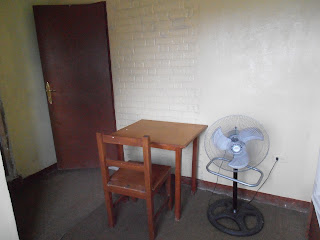
 The room I shared with another team member

 I am always happy when there is fan.

 Bathroom with running water

 The water pressure was quite low, so bucket baths were the way to go

One of the main highlights of our trip was meeting the U.S. Ambassador--Linda Thomas-Greenfield--to Liberia. As one of my first assignments, I was able to arrange our meeting for October 31 prior to our departure. Since our team was so large, we met at the Public Diplomacy Building on the second floor in the Colin Powell Conference Room. This change in venue meant that there was minimal security and the opportunity for photographs. Here is a picture of our group with Ambassador Thomas-Greenfield.


This was an insightful meeting, because the Ambassador shared with us about their activities with the elections. They had been actively engaged with the young people sensitizing them on the meaning of democracy and how their vote should not be bought or manipulated. She and her staff kept in close contact with many youth leaders so that they could diffuse any non-peaceful acts being instigated by any of the political parties.

The Ambassador also mentioned that she and her staff were part of the many observers of the October 11 Election at some 50 voting sites. She personally oversaw the vote count at Waterside, which is a section of the City of Monrovia. She was quite dismayed by the accusations of voter fraud when each site had both national and international observers present to ensure transparency with the counting.

She also shared some of the other activities the Embassy has been involved in. One of the main ones is education. They had about 39 Peace Corp Volunteers with all but four teaching in 24 high schools in Liberia. These volunteers were also training and certifying Liberian teachers.

The Peace Corp's return to Liberia in 2008 was one of many signs that the peace is progressing in the right direction. The Peace Corp had served faithfully in Liberia from 1962 to 1990, but were disbanded during the civil war. Another positive sign that was shared by Ambassador Thomas-Greenfield was the return of the families to the Embassy. Her face lit up when she commented on the number of babies that have been born to the staff members and how nice it was to have children back at the Embassy.

The Ambassador stressed one interesting point that aligned with our mission's purpose--healing and reconciliation. She stated that most, if not all, Liberians were dealing with trauma issues. This prompted me to remember an article I had read over a year ago titled "One Psychiatric Hospital for 3 Million People, Liberia Plan for Change." So, I asked her "isn't there one psychiatrist for the entire nation?" Her response was that person was not practicing, because he was working at the Ministry of Health and Social Welfare. This inspired one of our team members, the LMA's current executive director, to reconsider getting his PhD in psychology.

Clearly, 14 years of civil war would not only leave physical scars, but also mental ones. This reality made our mission to promote healing and reconciliation even more important. The task at hand was not easy, because the elections opened some old wounds and those hurts still impact the lives of many Liberians.

This is where I will conclude this post. Next week, I will continue with part 2 and share more about our conferences in Kakata and Monrovia. Until then, peace to all!


Saturday, October 8, 2011

Empowered Women and the Nobel Peace Prize

We just witnessed a great moment in human history as three strong and courageous women--President Ellen Johnson-Sirleaf, Leymah Gbowee and Tawakul Karman--were awarded the Nobel Peace Prize. These women represent developing nations that have not always valued and respected women as leaders and advocates for change.

This pivotal moment will, if it hasn't already, galvanize the sisterhood of women all around the world. Unlike the other prize holders, these honorees represent women of color, women of all faiths, and women fighting for social justice and human rights in all nations.

I celebrate the recognition of these three women and all women, who value love and compassion as a means to making this a better world. We are living in time where more and more women are taking an active role in democracy movements, standing up to tyranny, and fighting for their rights. There are three great examples of this movement in 2011 that are worth noting.

Let's not forget the women of Egypt, whose voices were lifted earlier this year as they demonstrated for a peaceful change of power. These women followed in the footsteps of their Liberian sisters by demonstrating with love. For instance, many of us were captivated by the image of the woman kissing the police officer on the cheek, which left him dumbfounded. The Egyptian women risked their lives to speak out and advocate for change, because they are tired of the status quo and wanted their children to have what they have been denied.

Let's not forget Dr. Hawa Abdi in Somalia, who stood up to rebels seeking to destroy her hospital and harming the people she was helping. Here is a woman, who used her land to build a clinic, school and feeding program to support 100,000 people who have been displaced by a 20-year war in Somalia. This selfless women on May 5, stood her ground as about 750 militants entered her property. She was placed on house arrest for five days shuttering operations causing two dozen children to die. Quickly the women in her community responded and began to protest followed by the condemnation of the Somalian diaspora. This is when Dr. Abdi demanded a written apology for their deadly intrusion, which they begrudging gave to her.

Let's not forget the women in Saudi Arabia, who are defying an unjust law that denies them the right to drive. These women have risked being arrested and even flogged by openly driving vehicles and posting video of being behind on the wheel on Facebook for the world to see. Recently the King gave them the right to vote and run in municipal elections starting 2015. Also, the King revoked the flogging penalty on women who were arrested for driving after a great deal of international outrage for this inhumane punishment.

These are just a few of the many women who are dedicating their lives and livelihoods to non-violent movements in their nations. The three Nobel Peace Prize winners have empowered women around the world, who stand for justice and peace, with new hope and motivation to continue their journeys in being force of change.

Friday, June 11, 2010

Life is a bumpy ride...

Life is an interesting journey, because no matter how well we plan out our destinations something along the way detours us down a different road. This alternative route is often a bumpy ride filled with pot holes of uncertainty and ruts of despair. However, as we navigate our way through this rough terrain we discover a new world that is filled with even more possibilities. Surprisingly, it is only the risk takers and adventurers who are willing to bypass the main thoroughfares of life to venture into this new land of hopes and dreams. For those who are willing to set out on such a quest they find that it was well worth it in the end.

My journey has detoured me from maintaining my blog. It is not that I lack the stories or ideas, it is just taking the time to sit down and write. The main detour of writing posts has been seeking permanent paid employment since my return from Liberia in January. During my first two months of job searching it felt like I was stuck in the mud and the prospects of getting out seemed unlikely. Then I was able to land a temporary job and for the next two months I was able to earn an income while rethinking the job search.

This two-month temp job was very much needed, because when it ended I had a re-surge of energy to strategically focus on the steps I needed to find employment. The first step was joining a job transition networking group, so I could get the vital tools and resources plus the weekly support. The next step was determining what credentials I was lacking and how I could change that. Fortunately, I was awarded a scholarship that covered 63% of the tuition for a two-week fast-track project management certificate program starting July 26. The last was signing up with a program that will give me one-on-one support and additional resources and tools in defining what I am seeking. These three steps may have not happened if I was not willing to take a different route.

It is nearly five months since I have returned from Liberia, and yet not a day goes by that I do not think about my experiences and the many adventures (or misadventures) I had while living there. After dedicating a great deal of heart, energy, time and money working with and serving the people of Liberia it is my intention that I continue my work in West Africa. I hope I can find an organization that can best utilize my skills, experience, and knowledge; one that provides the resources (micro-credit), the opportunity (business development training), and respect (cultural revitalization) that will empower marginalized people to regain dignity and obtain independence from charitable hand-outs.

This is just the beginning of my journey that I hope will continue down a different path, because there is so much more I want to explore. So it is my hope as I venture along this unpaved road that I can restart my blog to share my experiences since who knows where this quest will take me.


Tuesday, February 23, 2010

Transitioning back to U.S. Living

As time has elapsed so quickly into the new year, I noticed that it has been over two months, since I have done any serious writing. I have been struggling with putting my thoughts into writing during this time, because certain life’s stressors were blocking my creative flow. So, after a long absence without sharing my experiences and stories it seems that now is a good time to start writing again.

So much has happened since entering 2010 that my life is in total transition right now. First, I had to return abruptly to the U.S. on January 18 to resolve some concerns that had arisen during my time in Liberia. Surprisingly, this is the second time within an 18-month period where I was summoned home after residing in Liberia for one year. And in both situations my dreams and plans were stymied by the fallout of a failed business partnership in Liberia in which one of the four partners had misappropriated the construction funds and project supplies and equipment.

Secondly, after having no success finding non-profit paid work in Liberia, I returned home seeking employment in one of the toughest job markets in U.S. history. According to a 2009 second quarter Job Vacancy Survey from the Minnesota Department of Employment and Economic Development, there are eight job seekers for one job posting, so this translates to “240,000 unemployed workers competing for 31,000 unfilled jobs” in my home state (source: Jobs Now Coalition). However, while these statistics are daunting to this eager job seeker, it is far better than in Liberia where their unemployment still stands near 85%.

Thirdly, with living abroad since June 2007, minus a seven-month break to complete my bachelor’s degree in 2008, I no longer have a home, vehicle or other household possessions. As part of my marriage dissolution agreement, I gave up my interest in our home since neither one of us could afford to buy-out the other due to financial constraints of the failed business venture. Also, to graduate debt free I sold my prized 2004 Jeep Wrangler to cover my final semester’s tuition that was paid with my credit card. My final tuition bill was rather costly, because I had registered for 40 credits—combination of classes and independent studies—during my last semester of college.

Fourthly, returning to Minnesota during the winter has been very difficult, since I left the tropics for the bitter cold and dry weather. Even after being back for over a month, I am still FREEZING! Besides wearing two layers of clothes, my winter coat usually remains on while I am inside. At night, I sleep covered with flannel sheets, three blankets and a down comforter to keep warm. Then there is the problem with the cracking and flaking dry skin that takes continual applications of lotion to only give temporary relief. The drastic weather change has taken a toll on me, since I still struggle to adjust.

Lastly, there is the cultural shock. The adjustment of returning to the "land of plenty" after living one year in a post-war developing nation is a day-by-day process. Since my economic means in Liberia was stagnant, I lived on a very tight budget
[hand-to-month]. I adapted to not having running water or 24-hour electricity, since these sources have not been restored yet in Liberia. I survived mainly on one meal a day, which occasionally was dry rice (i.e. cooked white rice) and an egg fried with onion and African pepper. Though a vehicle was usually at my disposal, there were times that I crammed into an overcrowded taxi or bus to transport me to town or home. As someone who was accustomed to a higher standard of living before June 2007, I was living for the past year on what would be considered upper-poverty level in Liberia.

What I just described were a few of the transitions that I am facing right now. And as I go through this process, I remain cautious, because I do not want to forget what I endured during this past year. Though it seems that the daily struggles in Liberia would be hard to erase, I cannot ignore how easy it is to assimilate into the structured U.S. system to where your life seems like a computerized program. These experiences living in Liberia have shaped and changed my life so drastically that my existence in this world resides in two countries. This makes the transition between the developing and developed world that much harder.

So since returning home, I have been actively seeking employment while considering my plans to pursue a law degree. I have been keeping pretty flexible with my employment options including type of job and location as long as it is near a law school. As I focus on these goals, my returning to Africa remains in sight.

It is my hope after languishing in uncertainty for over two and half years that the doors of opportunity will soon open. I am ready to go through those doors as I create a new life that is bound with a sense of compassion and humility for those who live on practically nothing. After experiencing many heartaches and losses of my own, I want to go forward with my dreams and goals of giving voice to those who screams of suffering are continually ignored.

Sunday, February 14, 2010

I will return to writing soon!

I must take this time to apologize to my followers for this unintentional blackout with my blogging. A great deal has happened in the last three months that prevented me with maintaining this blog. I will soon be writing some new posts along with adding some published articles from December and January.

Many Blessings,

Heather

Thursday, December 10, 2009

Our One and Only Planet, What Can We Expect from COP15 (Part 1)

(This article was published in the print version of Liberia's Daily Observer on Thursday, December 10, 2009.)

While many people in developed nations are aware of the UN climate change conference COP15 being held in Copenhagen from December 7 through 18; however, what they might not be aware of is how important this conference is to the people of developing nations like Liberia. The people living in some of the poorest regions on the earth are already experiencing the devastating effects of climate change. This mere fact proves that the impacts of human activities in one part of the world can greatly alter the lives and livelihoods in another part of the world. It is clear that based on the evidence that global warming is a worldwide concern that is not obstructed by borders or boundaries.


One of the many challenges of these talks is to sensitize the leaders and people of the industrialized nations that they carry the greatest responsibility for the shift in temperatures around the world from their manufacturing plants emitting high amounts of carbon dioxide into the air to the high energy demands for transportation and other modern day conveniences creating an over consumption of fossil fuels. The people of developing nations cannot afford to be no longer heard since they are witnesses to major environmental shifts such as extreme droughts and flooding that have weaken their seasonal crop production and caused many to flee their homes being forced to rely on international aid programs for food assistance.

This conference is bringing together approximately 34,000 delegates of scientists, environmentalists, journalists, grassroots organizations and many other people representing 192 countries to address this critical escalating problem. Also, 100 heads of states or government including US President Barack Obama, China’s Premier Wen Jiabao, Indian Prime Minister Manmohan Singh, Brazil's President Luiz Inacio Lula da Silva and leaders of the European Union (EU) who are set to attend a climax summit on December 18 (Curtain Set to Rise on Climate Change). According to Yvo de Boer, executive secretary of the United Nations Framework Convention on Climate Change (UNFCCC), this conference is calling for an international agreement of the following four essentials (von Bülow, March 2009):

1. How much are the industrialized countries willing to reduce their emissions of greenhouse gases such as carbon dioxide (CO2)?

2. How much are major developing countries such as China and India willing to do to limit the growth of their emissions?

3. How is the help needed by developing countries to engage in reducing their emissions and adapting to the impacts of climate change going to be financed?

4. How is that money going to be managed?

This conference is addressing a problem that will not correct itself. Clearly every human has played a part in contributing to the problem of global warming no matter how small or large. However, for the people of developing nations their contribution is negligible compared to the people of developed nations. There is no dispute that industrialized nations like the U.S. use more than their share of the world’s supply of non-renewable natural resources like fossil fuels, and essential life sustaining sources like fresh water.

Since the Industrial Revolution in the 18th century, manufacturing companies have been a major contributor to air, soil and water pollution. Also, commercial farming and urban development have stripped away many forests, natural habitats for other living creatures, and precious top soil for growing food and other plant life. With this ongoing advancement of technology and the expansion of human settlements several animal and plant species have gone extinct forever, natural protective barriers such as the mangrove swamps have been destroyed that can no longer hold back the surging sea water, and large sections of land that were cleared of trees for agriculture purposes are being threatened by desertification. These significant changes in our environment can be seen and felt all over the world.

Based on these destructive human generated activities, it would seem as if people feel that another planet is waiting for us once we have destroyed this one. Who knows maybe some people believe that since scientists have discovered how to clone other living things like Dolly the sheep that they are in the process of cloning another earth.

Strangely, some theorists have gone so far to claim that Mars was the Garden of Eden and Noah’s Ark transported us to settle on earth when the “red planet” could no longer support life. As crazy as this notion sounds, it sure seems that humans have taken for granted that this one planet that we all call home is also a living being that can be destroyed and even die. Now in the 21st century as the fate of the earth is unknown, scientists and theorists are debating on whether human colonies can be supported on Mars if the earth becomes uninhabitable because we lost the battle to global warming (Moore).

Regardless of these theories, the planet earth has its own history and there have been certain occurrences that should caution us in being over-confident or arrogant in believing that we humans cannot cause our own extinction.

First one comes from a scientific perspective regarding the extinction of the greatest creatures that once walked the earth, the dinosaurs. For decades archeologists have been uncovering the fossils and remains of these gentle or fierce beasts. They have examined their bones and reconstructed them into skeletal frames to learn more on how they once lived and what may have been the cause to their destruction as a species. There is more than one theory that exists about their untimely death, and yet many of us stand in awe as we look up at these mighty beasts displayed in museum exhibits around the world wondering how such creatures ever existed.

The second one comes from a religious perspective. God one day decided to purge the earth of all the living creatures, because they had become corrupt and violent. He commanded Noah in building an Ark that would safely carry his family and two of each animal living on the earth. That fateful day came where for 40 days and nights the great rains flooded the entire earth wiping out every living thing. When the rain finally stopped it was a new dawn for life of all the species that had been finding refuge on the ark (Genesis 6:1 to 9:17).

Granted, God made convent with Noah to not flood the earth again; however, who knows God might have the prerogative to have a change of heart. There is no dispute that human corruption and violence continues to be our destiny. If God decides to purge the earth again maybe this time humans will not be selected to build the next ark or even be included as one of its passengers.

Of all living creatures, humans are the most destructive and violent beings on this planet. For several centuries now, we have waged war over religious differences, acquisition of large tracts of land through colonization, and also of natural resources and minerals such as oil, diamonds and gold. In this century and beyond wars could be waged over limited supplies of food and fresh drinking water, because we failed as the collective human society to ensure proper and equitable distribution of these essentials to life.

Anyone who has stepped beyond the borders of the developed world knows that we use and waste more food, energy and water than in the developing world. How is it that a smaller population of world’s people living in developed nations uses greater amounts of water and energy while large populations of people living in the developing world are starving and living in extreme poverty? This question can no longer be ignored by the developed world, because the amount of CO2 and other green house gases that have been emitted into the atmosphere have altered the natural cycle of our climate where the increase of global temperatures are having devastating effects, especially in the developing world.

In fact on Tuesday, December 8, the Associated Press reported that “the U.N.'s weather agency boosted the sense of urgency surrounding the conference with data showing this decade is on track to be the hottest since records began in 1850, with 2009 the fifth-warmest year ever. The second warmest decade was the 1990s.” Also, from scientific analysis of tree rings and retreating glaciers conducted by the U.S. National Academy of Sciences they cited that “the last few decades are the warmest period in at least 400 years and probably 1,000 years” based on the evidence they found in their research (Heilprin).

Therefore, the Copenhagen conference is an important convergence of people from many nations and backgrounds to find equitable solutions for this global concern. According to Connie Hedegaard, Danish Minister for Climate and Energy and incoming COP15 President there must be an accord reached by the delegates in effort to “seal the deal” among the nations represented. She views this conference as “window of opportunity” since the momentum is at its highest point ever. Otherwise she commented that “if the whole world comes to Copenhagen and leaves without making the needed political agreement, then I think it’s a failure that is not just about climate. Then it’s the whole global democratic system not being able to deliver results in one of the defining challenges of our century. And that is and should not be a possibility. It’s not an option (von Bülow, October 2009).”

As the world waits for the results from COP 15, we must take a moment to realize that we are fighting for our future existence. We must realize that the earth is a miracle that was created to be our one and only home, which we have been entrusted with its care and preservation of its life-giving and life-sustaining resources. No matter our culture, religious belief, experience or education, we are united as one family and like any individual household we must learn the process of sharing and conserving the earth’s resources to ensure peace and harmony. If we can practice this simple rule from the individual household to our global home then this would be the greatest achievement ever accomplished in human history.

References:

Curtain set to rise on climate summit. Yahoo!® News. 06 December 2009. 08 December 2009
http://news.yahoo.com/s/afp/20091207/ts_afp/unclimatewarming_20091207024730

Heilprin, John, and Charles J. Hanley. Leaked document stirs anger at climate summit.
Associated Press. 09 December 2009. 09 December 2009 http://www.google.com/hostednews/ap/article/ALeqM5i9TuMrvrknh-ZXwqmZ2N-48kff3wD9CFMQ380

Moore, Matthew. Human colony on Mars 'will make the world a better place’. 09 September
2009. 08 December 2009 http://www.telegraph.co.uk/science/science-
news/6162355/Human-colony-on-Mars-will-make-the-world-a-better-place.html

von Bülow, Michael. The Essentials in Copenhagen. COP15. 16 March 2009. 08 December 2009
http://en.cop15.dk/news/view+news?newsid=876

von Bülow, Michael. Failure in Copenhagen is not an option. COP15. 02 October 2009.
08 December 2009 http://en.cop15.dk/news/view+news?newsid=2257

Tuesday, November 17, 2009

Life without 24-hour Electricity

It is funny how we take certain things for granted like electricity. For example, in the U.S. we enjoy 24-hour running electrical current, but when there is an outage whether for just a few hours or even a few days we feel totally deprived for that moment. However, once the power is restored we soon forget the inconvenience and go about our day.

Well, 24-hour current in Liberia is only for those who can afford to run their generators morning and night. Keep in mind generators are normally used for back-up electricity; however, in Liberia they are the primary source. So, for the lucky few who have more than one generator and the money to keep them fueled, they are ones to maintain 24-hour current. Though there is brief interruption when exchanging generators either once or twice day to reduce the machines wear and tear, especially for those that carry a heavy electrical load. However, the vast majority of Liberia's people do not have generators, so they rely on candles or flashlights for their evening light and battery operated radios for their entertainment.

In my case I have a 2.5KVA (kilo-volt amps) generator. This size of generator produces enough electricity to operate a fan, small freezer, lights, TV, laptop computer, and charge cell phones and a camera. It runs on gasoline and the current price in U.S. is $3.10 per gallon. I have had to economize my expenses, so I run my generator from 10PM to 4AM allowing me to sleep in comfort with my fan. This six-hour span takes one gallon of gas. If you calculate the cost of one gallon of gas with average days in the month, this six hours each night equates to $93 per month. If it was possible to run my machine 24-hours daily, it would cost about $446 per month in gas. However, these machines need engine oil, spark plug replacement, and other servicing each month so that cost could be close to $500.

In retrospect, I do not remember paying near that amount for my townhouse in the U.S. during the hottest month of the year with running my central-air unit, large and small appliances, and having several lights on throughout the house. But now I realize how we take 24-hour electricity for granted, because we have gotten accustomed to it by enjoying our many modern comforts. So, we are oblivious to how we can easily waste energy just to satisfy these needs.

Well in Liberia, where this luxury is not so convenient, you yourself wishing for 24-hour electricity. As we enter December, it is a reminder that the rainy season's cool weather is about to change to the dry season's intense heat and humidity. This is the time I hope that I can find a way to run my generator more so I can escape the unbearable steamy heat of the afternoon to evening hours. On days like this it can be a simple heaven just to run your fan for a few hours to cool down.

As someone from the U.S. I know that we often take for granted how blessed we have it in our country. We may complain and fuss on how hard daily living is in our perspective, but compared to people who struggle just to survive on daily basis we have it pretty damn good. Life without 24-hour electricity is a challenge, but you have to learn to cope with what you have. I have learned to be grateful for having a generator to provide me some of the comforts I am used to regardless if it is a few hours a day.