Showing posts with label Ebola. Show all posts

Saturday, December 19, 2015

Liberia: Delivering School Supplies to City of Joy

Our generous Star Supporters helped spread joy to not one, but three schools with our 2015 school supply drive. This year we changed our campaign from collecting and shipping supplies from the U.S to purchasing them in Liberia as means to support their struggling economy. Our cups overflowed with joy on August 6, when of our lost 2014 shipment finally arrived. This miraculous moment increased our outreach by 200%. During September and October, UDS volunteers and youth group attended three back-to-school programs at City of Joy, Rogma International and Russ Wood Christian Academy to deliver supplies to their respective students.

On Sunday, September 6, City of Joy School in Congo Town held their school opening program. Pastor Nathaniel J. Gray founded this small primary school, which shares the same building as his church, to serve young children in his community. Pastor Gray partnered with Hossana Children Foundation, founded by Godfrey Solomon and Bernice Nyuma. These two young men and woman work together to improve the lives of children in their community. Both organizations are fairly new and working without an office or any sizable budget.

The morning of the program, UDS volunteers were busy sorting, organizing and placing the supplies into individual packages for each student. They also prepared popcorn for each student to receive with their package.

Left to Right: UDS Volunteers--Mohammad Sesay (gray shirt), Princess Fomba, Fayiah Nyuma (striped shirt), and Moses Lahai (not pictured) carefully prepare each school supply package for City of Joy.

UDS Liberian Co-Founder and Country Director, Kelvin Fomba, was invited as the guest speaker for this program. The event attendees included school staff and teachers, parents and guardians, students and members of the community. Kelvin opened his talk about UDS programs serving children and youth. He then invited students to visit our newly opened Learning Center to help with their homework. He ended his talk with a call-to-action to support City of Joy. The response was tremendous! Up to seven scholarships were given along with other financial and in-kind donations. It was nice to know how UDS supporters stimulated this community's desire to do more to serve young students attending grades pre-school to sixth.

Standing from left to right: Pastor Nathanial J Gray (City of Joy), Kelvin Fomba (UDS), Godfrey Solomon and Bernice Nyuma (Hossana), Daniel Lloyd (UDS volunteer and Russ Wood Vice Principal), and Moses Lahai (UDS volunteer)

Later in the program Kelvin and Moses Lahai presented each student with their gift packet of supplies and a bag of popcorn. They were assisted by Bernice Nyuma (Hossana) and our newly formed UDS Youth Group. The next four photos show students receiving their wonderful gifts made possible by our Star Supporters.


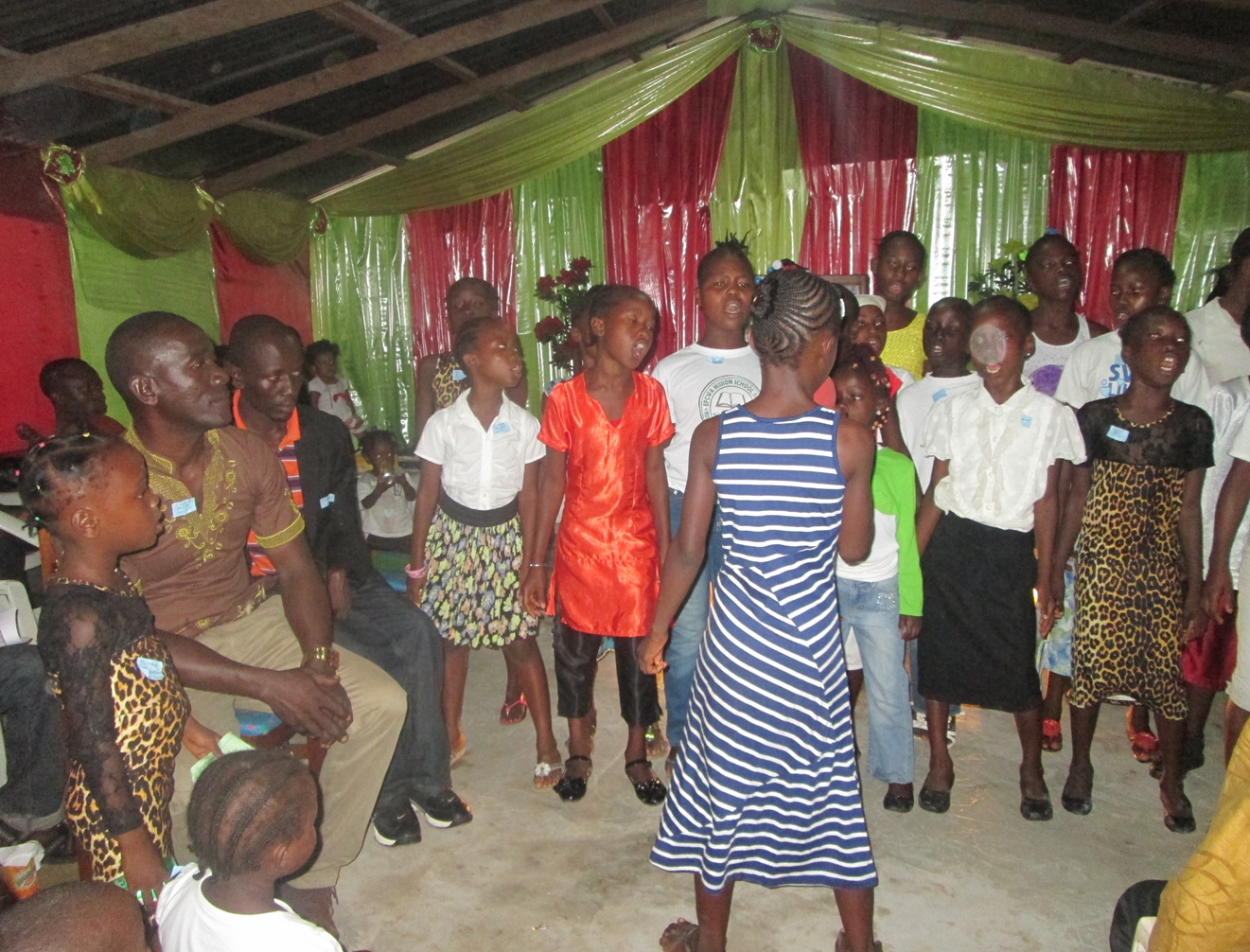
This program also showcased some talented young people. Our youth group organized and performed a popular song that lifted people out of their seats to dance. City of Joy students performed skits, sang songs and danced in celebration of their joyous day!

UDS Youth Group beautifully singing a popular song.

City of Joy students joyfully sing to their adorning audience.

All the photos from this day show how our supporters' generosity and kindness put smiles on the faces of City of Joy students knowing their education matters.


Please visit UDS Facebook album to see more photos of City of Joy's program.

Our next two recipients of our 2015 school supply drive campaign are Rogma International School on September 13 and Russ Wood Christian Academy on October 11. UDS started supporting Russ Wood in 2012 and were eager for the students to receive their supplies in our youth-made backpacks. These backpacks were part of project piloted in 2014 during the height of the Ebola crisis.

The continued support, encouragement and concern for our youth in Liberia from our generous community is forever appreciated. Our work is made possible, because of your support. All of UDS is extremely grateful for that!

Photos and videos taken by Rodney John, UDS Volunteer

Thursday, November 26, 2015

Uniting Distant Stars Gives You Thanks!

Dear Star Supporter: Today is Thanksgiving in the U.S. and we want to extend our heartfelt Thanks to you! Your generous support put smiles on countless Liberian children and youth through our Backpacks for Peace training, Nobel Peace Prize Youth Forum Google Hangout, school supply distribution, learning center opening and so much more. Our Liberian volunteers, youth group, and all students are extremely grateful for your prayers and concerns for their safety and well-being with having to endure Ebola. Your love and kindness gives them hope and joy to continue to move forward with their goals.


We appreciate you more than all the stars in the universe!

Peace and blessings from Uniting Distant Stars

Saturday, March 14, 2015

UDS Youth Vitually Participates in the Nobel Peace Prize Youth Forum

For the second consecutive year, Uniting Distant Stars, Inc. (UDS) in Liberia participated via Google Hangout in the Nobel Peace Prize Youth Forum (NPPY Forum) at Augsburg College in Minneapolis, Minnesota on March 6, 2015. This was a unique experience for our 50-plus youth representing students in primary to college level as well as young people unable to attend school due to financial reasons. 

We displayed this banner at the beginning of the week and it spawned great enthusiasm by our young beneficiaries. This was donated by our two co-founders--Kelvin Fomba (Liberia) and Heather Cannon-Winkelman (United States)
In preparation of this much anticipated event, our Country Director Kelvin Fomba held a workshop the day before. He reviewed the activities along with sharing some background on the Nobel Laureate, the Organisation of the Prohibition of Chemical Weapons (OPCW), who they would be listening to during the forum. Also, they watched the TEDTalks of William Kamkwamba from Malawi and Kelvin Doe from Sierra Leone for some additional inspiration.

Left photo: Kelvin conducting the workshop. Right photo: our youth watching William Kamkwamba's TEDTalk "How I built a windmill".
On the day of the event, our organizing team in Liberia was eager and ready to connect about two hours before the forum started (Liberia is six hours ahead of Minnesota). Shortly after the program opened, our youth were given a warm and hearty welcome from their Minnesota peers when they popped up on the two large screens on both sides of the stage at Augsburg's Kennedy Center gym. This is the moment that made this experience real to our youth as they saw over 600 Minnesota students waving and saying Hello to them.

This photo was taken by UDS Executive Director at the forum when the Liberian youth appeared on the screen during the welcome at the forum. (The lighting was challenge to taking photos of the screen.)
As the program continued, the emcees of youthrive, the organization that produces the NPPY Forum, took a few moments to review their four simple rules for engaged leadership--Show Up, Speak Truth, Change Yourself, and Lead! The Change Yourself rule was the one that intrigued our youth the most. This led into a more detailed discussion after the forum on why this is important in order to bring about positive change in their communities.

Kelvin (red shirt) talking with our youth at the forum at the start.
Next, our youth were captivated by the talk from Leiv Sydnes of the OPCW and they gained a great respect of this organization's dangerous, but invaluable work on eradicating the world of chemical weapons. At one point during his presentation, he showed a slide of a patient being treated for chemical burns that had the doctors wearing masks and hazmat suits similar to what they saw with the Ebola outbreak. This sparked a discussion with Kelvin on whether Ebola was a chemical weapon. He explained how many chemicals have no smell or can be seen, and like Ebola these suits are worn for their protection.

The banner is hanging with two rain suits next to it on each side. These rain suits are created with the same plastic used for the backpacks. Also, hanging on the wall on the left side is one of the backpacks made during the first phase of this project.
At the end of Leiv's presentation, our youth were the first ones to ask him a question. They were interested in knowing the OPCW strategy in how they will eradicate production and uses of chemical weapons in order create world peace. Leiv responded by saying that chemical weapons only represents a small percentage of the issues challenging world peace. So while the OPCW is working on their part, these other areas of concern such as wars need to addressed as well.

Here our youth watching the forum in Liberia. The two youth in the front on the right are drinking water from the plastic sachets that are used for our Backpacks for Peace program.
The final activity that involved our youth was the World Cafe. The purpose of the World Cafe was to have the young people divide up into smaller groups and spend 15 minutes each on three questions involving peace and community building. Our youth participated in this activity simultaneously with the Minnesota students. After each question's discussion, the individual groups had to agree on one idea that could be shared later to everyone. These ideas would be transformed into themes that would become actionable initiatives.

Here is a candid moment with some of our youth.
Here are the responses (edited for clarity) from our youth that were emailed to youthrive to be shared with the Minnesota students and we hope to receive theirs soon to learn more about each others challenges and perspectives.

1) What does a peaceful environment in a community or school look like to you?

A peaceful environment in a community or school means a lot to us in Liberia. The most important aspect is development, because whenever peace exists there must be development such as quality schools, job opportunities, etc. 

2) Think about your own community or school… What kind of things have happened that wouldn’t be described as “peaceful”?

A lot of things happen in our community and schools that would not be considered peaceful due to a lack of well-trained security officers, equitable justice, etc. For example, during the EBOLA crisis, some youth were killed by military personnel in the West Point community (a large slum) in Monrovia, and since then nothing has been done about this incident.

3) Think about what was said in Question 2… What kind of things can you do to take action in making your community or school more peaceful?

The Liberian youth are appealing to the world to help train the security, so that they will be able to protect the people and the entire nation. The youth are also pleading to get support in education and vocation training, because when you are engaged in any good thing this will help young people to be more focused with school and work.

The refreshments being served in this photo was organized and prepared by our own volunteer Princess Fomba. UDS provided sandwiches and soft drinks to everyone present.
In regards to their response in question 3, UDS is active in addressing their plea by offering scholarships and providing vocational training opportunities such as our Backpacks for Peace and automotive apprenticeship program for mechanics and drivers. However, we like to work with our youth more in seeing how they can find ways to respond to these concerns.

At the end of the program in Liberia, our youth created two groups--young ladies and young men--and each sang a song to Thank UDS for their participation in the forum.
In reflecting on this most memorable day, our youth expressed their interest in starting a group that would fall under Uniting Distant Stars. They exchanged numbers with each other, so they can plan a time to meet. We will support them as they move forward with any plans in making this a reality. Also, they stressed the importance of being involved in this forum or similar programs, because it was an enriched educational experience that is currently not offered in their schools.

Here are some youth expressing their joy at the end of our involvement in the forum.
We want to end this post by giving a much deserved Thank You to the UDS organizing team lead by Kelvin Fomba in Liberia and our donors in the United States and Denmark; youthrive's staff--Maddy Wegner, Donna Cook, Callie Aguilar, Anne Parish, and their youth trainers--Malika Musa and Kevin Nguyen; and the Nobel Peace Prize Forum tech team including Mark Holterhaus and Adam Davis-McGee for making this event possible for our youth in Liberia!

Before you go...here are some special videos from our youth that were taped after the forum.

  
UDS girls and young women created this Thank You song for Uniting Distant Stars.

  
UDS boys and young men created this Thank You song for Sundance Family Foundation, who gave the $3,000 grant for the Backpacks for Peace Service Learning Project.

Sunday, January 4, 2015

Peace on Earth, Good Will to Everyone, and Thank You

It is said that we are each born to this earth with a purpose to do something that will contribute to the betterment of all living things. Our destiny is usually greater than our sense of self, if we are open to the sights and sounds that lead us on this inspirational journey. As we move out into this world, we will unite with others who share the same passion and work together to build community, harmony and peace.

February 2014 Student Celebration at Russ Wood School.
Uniting Distant Stars exemplifies this calling. It started with two people--one U.S. citizen and one Liberian--who combined their shared passion to encourage young people to reach for the Stars. Soon others joined from Minnesota, Oklahoma, Missouri, Wisconsin, North Dakota, Liberia, Cameron, Ghana, Eritrea, and Denmark to support Liberia's youth to reach their potential with educational scholarships, rejoicing their achievements at the Annual Student Celebration and School Gala, innovative training program such as the Backpacks for Peace, opportunities to connect with their peers in Minnesota via Google Hangout at the Nobel Peace Prize Forum Youth Festival, and much more.

March 2014 Nobel Peace Prize Forum Youth Festival via Google Hangout.
The children and young adults that we have partnered with in Liberia have been very grateful for the community of support that has been developed through Uniting Distant Stars. In the later half of 2014, their lives were abruptly interrupted by Ebola with schools being closed and having their families livelihoods restricted or devastated. However, this crisis did not destroy the dreams and hopes of Liberia's precious young souls. They have shown their desire to be learning and doing something that allows them to be self-reliant. We are grateful that we can give our young men and women this opportunity with our backpack project.

Completion of the Phase 1 of the backpack project in December 2014. Our team on right made 250 backpacks for our students at Russ Wood Christian Academy. These will be filled with the supplies were shipped Trans-Atlantic in November and given at the 3rd annual Student Celebration sometime in 2015.
What we have accomplished in the last few years would not have been possible without the most generous support of our dedicated donors, board members, volunteers and followers who help share our story. Each and everyone of you is a Shining Star that has brightened the lives of our young people we serve in Liberia. Your kindness and encouragement has filled their hearts with joy and the knowledge that you are with them on this journey. It is so hard to find the right words to express what you have done to make a difference for the our young Star, except to say we are humbly and extremely GRATEFUL and THANKFUL for all of you in making 2014 a successful year!

We wish all of you and your families Peace on Earth, Good Will, and the Happiest and Blessed 2015!

Monday, December 1, 2014

Backpacks for Peace: Project for Learning and Giving

In the spirit of this season of giving, we welcome your contribution to inspire 20 youth in making 300 Backpacks for Peace through our innovative training program. The cost of making a backpack is approximately $10, so a generous gift of $50 will get us that much closer to our goal. For the second year in the row, Uniting Distant Stars will invite some of Liberia’s promising young men and women leaders to participate in the March 6, 2015 Nobel Peace Prize Forum Youth Festival organized by youthrive, a Minnesota-based non-profit.

Three Liberian youth modeling our backpacks in each color--white, blue and red
The Backpacks for Peace project will instill peace building within the community and re-spark their creative flame by using recycled plastic to make the backpacks.  The first phase of the program focused on teaching four trainees on how to sew the backpacks and care for the sewing machines as future trainers of this program. The goal of the first phase was to make 250 backpacks to be given to the students at our adopt-a-school program as part of our 4th Annual School Supply Drive.

Video shows launch of our first phase of this project on 09/26/14; narrated by Kelvin Fomba, UDS Co-founder and Country Director.

Twenty young men and women from primary to post-secondary education will launch the second phase of our backpack training program the beginning of January 2015 by making 300 bags that they will give to the beneficiaries of the Straight From the Heart Center in Liberia. This center was founded by Agnes Fallah Kamara-Umunna to provide a space for rehabilitation, reintegration, and reconciliation for youth who were on all sides of Liberia’s Civil War. Agnes is the author of the book “And Peace Still Did Not Come: A Memoir of Reconciliation”.

Photos: Left is project team lead and professional tailor Charles Mamba sitting at his machine on left that he has donated for this project. Next two photos show three of the four trainees.
We have already raised $590 towards our goal of $3,000 to buy four more sewing machines and the supplies such as zippers and thread, to make 300 backpacks. Our partner—African Dream Academy—has been donating the recycled plastic drinking water sachets, the primary material for the backpacks.


No
Items
Qty
Unit Cost
Total Cost
1
Machine
4 each
190 USD
760 USD
2
Zippers
600 yards
2 USD
1,200 USD
3
Thread
3 cartons
50 USD
150 USD
4
Scissors  
5 each
10 USD
50 USD
5
Machine needles
3 packets
25 USD
75 USD
6
Machine oil
8 bottles
4 USD
32 USD
7
Cloth Lining
3 rolls
50 USD
150 USD
       8
Participant Benefits


583 USD


TOTAL
3.000 USD

Your contribution is not only tax-deductible; it is also developing a sustainable youth training program that teaches life-long skills in sewing and marketing a product needed by many Liberian youth. The need for rebuilding from the Liberian Civil War is still relevan, and it is even more urgent now due to the Ebola epidemic that recently devastated many families in Liberia.

Our team has been working hard and made nearly 200 backpacks when this photo was taken.
Please support our Backpacks for Peace service learning project with a donation by PayPal or by check to Uniting Distant Stars, Inc. and mail to:

Uniting Distant Stars, Inc.
4010 Lawndale LN N
Plymouth, MN 55446

Thank You For Your Generous Support

Sunday, August 17, 2014

Is Ebola a Game Changer for Global Health?


For many years Global Health initiatives have been focused on stopping the spread of HIV and AIDS or eradicating ancient diseases like Malaria. However, the recent Ebola outbreak in West Africa has severely tested the capacity of local and international health ageniess to treat their patients while protecting themselves from the onslaught of this deadly, but preventable disease. (View the Quartz interactive map to how this has spread so quickly).

In our last post "Wading through myths and facts of Ebola", we highlighted what was trending in the media that either terrified or mobilized people. In this post, we will explore the realities that are being faced in West Africa and its lasting impact on Global Health and International Development.

What we have learned so far, is that this six-month siege of the Ebola hemorrhagic fever has devastated entire families and rural villages. It has strained the economies of the three West African Nations--Guinea, Liberia, and Sierra Leone--to where impoverished people are forced to buy food and necessary supplies at inflated prices. It has also halted the progress of NGOs like ours. We all have had to shift our focus to awareness campaigns in order to protect our national teams and the communities we serve.

Now lets look at how Ebola is a game changer for Global Health? This was bluntly and succinctly expressed in the recent CSPAN video recording of Ken Isaacs, Vice President of Programs and Government Relations for Samaritan's Purse, as he testifies before the House Foreign Affairs Subcommittee. (Also read his New York Times Op Ed "Why Are We Ignoring a New Ebola Outbreak?" from July 24).


Here are the key facts and realities from his testimony that explains why this unprecedented epidemic has occurred and why more help is needed.

1) International Response Failure: he cited only two medical aid agencies--Samaritan Purse and Médecins Sans Frontières/Doctors Without Borders (MSF)--were on the front lines of this epidemic in the three bordering nations. While prominent agencies like World Health Organization (WHO) were stating things were under control for the last few months, MSF was stressing the opposite and pleading for more help and supplies. Recently the WHO has changed their stance by stating that "the West Africa's Ebola epidemic is an 'extraordinary event' and now constitutes an international health risk." (Read press release "Ebola: Official MSF response to WHO declaring epidemic an 'extraordinary event'" by Dr Bart Janssens, MSF Director of Operations, from August 14).

2) Unprepared Community Health Worker: one of the strategies of providing needed medical treatment of common diseases like Malaria and Typhoid, was to recruit and train local people to deal with basic and common ailments. These are moderately educated people, who were provided with some medical supplies and instructions on what medicine should be administered for what sickness or condition. Sadly these community health workers had no idea what Ebola was and were treating patients for what they thought were other illnesses such as Malaria that have similar symptoms. Many of these workers have contracted and died from Ebola, because they were uninformed of this rare and contagious disease. (Read a Thomson Reuters article "Ebola outbreak: High death toll among health worker 1st responders" posted in CBC News on August 9).

3) Stigma of the International Healthcare Worker: This is an issue on both sides of the spectrum. On one side, many of the MSF teams working in remote areas have been threatened by villagers with knives and stones believing the doctors are the cause of this disease. On the other side, Ken Isaacs testified the recently evacuated teams from Sanitarian Purse have struggled with returning home in their respective nations, because their families are unsure to hug them while others in the community have ostracized them.

4) No Mass Evacuations of Infected U.S. Citizens or International Workers: Ken in his testimony shared how he "recognized during the evacuation of our staff that there is only one airplane in the world with one chamber to carry a level 4 pathogenic disease victim." He was not able to know of any other plane except for this one in the U.S. So this greatly limits the U.S. capacity or any other country to do a mass evacuation of its citizens have been infected.  (Read Mashable's article "The Obscure Airline That Evacuated the American Ebola Patients" from August 9).

5) The Cost of Corruption: The local healthcare workers have struggled in this fight, especially when their own needs to survive have been endangered. Ken testified that "I know for a fact that in Foya, the second largest center where Ebola is manifesting in Liberia, the workers at the Ministry Health clinic were not paid for five months even after the European Union had put money for it. The money just did not get downstream."

6) Lack of Understanding at All Levels of Society: A major obstacle has been sensitizing the general population of what Ebola is and how it is transmitted, especially when trying to get people to stop certain cultural rituals. A major one is washing the body in preparation for the funeral, which is when it is most infected. Another concern was how well-educated and highly credentialed people in medical and government positions openly denied the seriousness of this disease and mocked the work of organizations like Samaritan Purse as cited in Ken's testimony. This led to the deaths of two prominent people in Liberia who believed this was not real.

There are two more things that I like to add to this growing problem that need attention:

7) Inequality: It was decided recently that all the Peace Corp Workers in Guinea, Liberia and Sierra Leone must be evacuated as a cautionary preventative as efforts are made to contain this disease. Sara Laskowski working in Guinea wrote a powerful blog post about how the Peace Corp evacuations put western privilege at center stage during this epic medical mayhem in West Africa. She shares how she has been living with her host family since the outbreak started. The Peace Corp setup awareness campaigns for their volunteers and the community they served that has helped minimize the impact of Ebola. As she was preparing to leave, she felt the unsettling pain of knowing that her life can be easily saved by moving her out of the affected area while leaving her community behind who are not afforded the same opportunity. 

She could see that the problem did not need to persist, but was instead intensified by stating: "Unfortunately, this outbreak has been severely mismanaged on two ends. Primarily, the Guinean government is not equipped to handle it but more tragically the Western world has chosen to feed the fire with sensationalized media instead of what we really need here in Guinea, Sierra Leone and Liberia – medical assistance, man-power, education, and funding."

8) Little to No Trauma Counseling: From the families to the health workers, they have witnessed the carnage of this disease on patients young and old. Many die from massive uncontrollable bleeding and other horrific ways that will haunt the surviving family members and the healthcare workers administering their care. It seems that there has been little to no attention on what aftercare is given to these people such as trauma counseling. The emotions and spirits of everyone is very much strained and without any supportive care, how will these people cope and manage with what they have seen and endured.

In listening to Ken Isaacs testimony several times and reading the reports about Ebola from MSF and other prominent medical organizations, I continue to learn more about how this disease can lead to global concern. According to the WHO Fact Sheet, Ebola has an incubation period of up to 21 days before its contagious symptoms emerge. Also, for men who recover from this disease, they still carry the virus in their semen for up to seven weeks. So with more people being able to travel around the world, the chances of this infecting other communities is much greater than previous outbreaks. This why some airlines have suspended service to this affected region while others have introduced screening for fevers and other notable symptoms.

Ebola definitely has uncovered gaps in how international aid organizations have operated and also strengthened the need for better education, sanitation and water systems, and healthcare as means to end poverty thus reducing such epidemics. This is why it is important for both Global Health organizations and other international NGOs to re-evaluate their programs and strategies to ensure that they are able to effectively serve and protect their communities to minimize the impacts of what Ebola has done in West Africa.